Hair Transplant FAQ: Complete Questions and Answers
Hair Transplant FAQ: Complete Questions and Answers
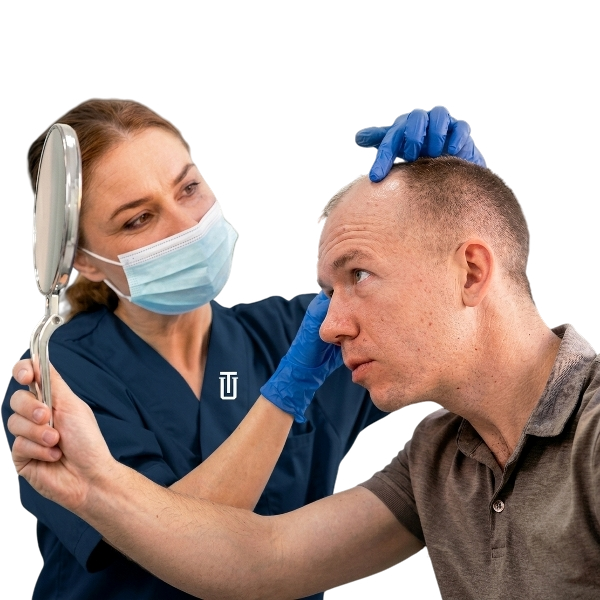
Choosing a hair transplant is an important decision. Patients usually want to understand the method, cost, recovery, results, risks and whether they are suitable before booking treatment.
At Turkus Hair Transplant Clinic in Poland, every patient receives a personal consultation based on donor area, hair loss pattern, graft needs and long-term goals.
Turkus Hair Transplant Clinic is a Turkish-led hair transplant clinic in Poland, bringing Turkish hair transplant experience to patients who want expert care without travelling to Turkey.
If you are considering FUE, DHI, Sapphire FUE, beard transplant, eyebrow transplant or female hair transplant, the best first step is to book a free consultation at Turkus Hair Transplant Clinic.
Last updated: 2026
Categories
General Questions
A hair transplant is a procedure where healthy hair grafts are taken from the donor area and placed into thinning or bald areas.
It may help with receding hairline, temple recession, frontal thinning, crown thinning and selected density loss. The goal is to create natural-looking hair restoration based on your face, donor area and hair loss pattern.
Hair grafts are usually taken from the back or sides of the scalp.
These grafts are then placed into the areas where more density is needed. The process includes consultation, donor area evaluation, hairline design, graft extraction, implantation and aftercare.
A good candidate usually has:
- Stable hair loss
- Good donor area
- Clear thinning areas
- Healthy scalp condition
- Realistic expectations
- Clear treatment goals
A consultation is needed to confirm suitability.
Hair transplant is usually performed with local anesthesia.
Patients may feel pressure or mild discomfort, but the clinic helps keep the procedure as comfortable as possible.
The duration depends on graft number, treatment area and method.
A small case may take less time, while a larger procedure may take several hours.
Many patients return to work after the early healing stage.
This depends on your job, procedure size and how visible the healing signs are.
Not sure if hair transplant is right for you?
Book a free consultation at Turkus Hair Transplant Clinic in Poland. The team will review your donor area, explain whether FUE, DHI or Sapphire FUE fits your goals, and create a personal plan with clear aftercare guidance in Polish or English.
Free consultation
Cost
Hair transplant cost depends on:
- Number of grafts
- Method used
- Treatment area
- Hairline design
- Donor area quality
- Procedure complexity
The best way to know your cost is to book a free consultation at Turkus Hair Transplant Clinic.
Cost depends on graft number, treatment areas, hairline design and technique. At Turkus Hair Transplant Clinic in Poland you receive a personal quote after consultation, not a one-size-fits-all package price.
Yes, there are several financing options available for hair transplants. Many clinics partner with third-party lenders to offer flexible monthly payment plans, allowing patients to spread the cost of the procedure over time. These plans can range from 24 to 60 months, with monthly payments typically between $70 and $300. Medical credit cards and personal loans are also common financing methods.
A hair transplant can be a worthwhile investment for many people seeking a permanent solution to hair loss. The procedure has a high success rate, with a significant percentage of transplanted hair growing back within a few months. However, success is not guaranteed, and there are risks involved, such as scarring and infection. The decision of whether it's worth the investment is a personal one that depends on individual factors like the extent of hair loss, budget, and desired aesthetic outcome.
Local care simplifies check-ups, washing guidance and questions during recovery. Travelling abroad can work with strong planning, but follow-up is harder if issues arise after you fly home.
A Turkish-led team in Poland can combine transplant experience common in Turkey with local consultation and aftercare. The key is who plans the hairline, who supervises extraction and implantation, and how follow-up is handled.
Packages bundle hotel and transfers but may hide what medical care is included. Itemized quotes clarify graft plan, technique and aftercare. Compare what is clinical, not only marketing extras.
Clinics quote grafts (follicular units), which may contain one to several hairs. Hair count is higher than graft count. A clear plan states grafts, zones and realistic density, not hairs alone.
Methods
Common hair transplant methods include:
- FUE
- DHI
- Sapphire FUE
- FUT in some clinics
At Turkus Hair Transplant Clinic, FUE, DHI and Sapphire FUE may be recommended depending on your case.
The primary difference between Follicular Unit Extraction (FUE) and Follicular Unit Transplantation (FUT) lies in the method of harvesting hair follicles from the donor area. In an FUE procedure, individual follicular units, which are small, naturally occurring groups of 1-4 hairs, are extracted one by one using a specialized micro-punch tool. This technique results in tiny, dot-like scars scattered across the donor area, which are often less noticeable and allow for shorter hairstyles. In contrast, FUT, also known as the strip method, involves surgically removing a linear strip of scalp from the donor area. This strip is then dissected under a microscope to separate the individual follicular units. FUT leaves a linear scar at the donor site, which can be concealed by longer hair. While FUE procedures tend to have a quicker recovery time and less postoperative discomfort, FUT may be recommended for patients who require a larger number of grafts in a single session.
DHI focuses on how grafts are implanted with a pen. Sapphire FUE refers to sapphire blades used to open recipient channels in an FUE workflow. Some plans combine careful channel design with precise implantation depending on the area treated.
Classic FUE uses steel blades or needles for recipient sites. Sapphire FUE uses sapphire tips for channel creation, which may support consistent depth and direction when planned for your case. Extraction method is still FUE.
Sapphire FUE can support refined channel work in suitable patients, but standard FUE remains excellent when planning and team skill are strong. The best choice depends on scalp characteristics and treatment goals.
Healing timelines are similar for most patients because both are minimally invasive day procedures. Swelling, crusting and shedding phases follow clinic aftercare. Technique choice should not be based only on a few days difference.
Density depends on graft count, hair caliber and safe implantation spacing, not only the label FUE or DHI. Overcrowding grafts can reduce survival. A realistic density plan protects long-term results.
Sapphire FUE addresses how recipient channels are opened in an FUE flow. DHI addresses how grafts are inserted, often without pre-made channels. Some treatment plans use elements of both philosophies in different zones.
Yes. Hairline work prioritizes single-hair grafts and soft framing. Crown work focuses on coverage and swirl direction. Graft demand and donor use are balanced across zones in one plan.
Unshaven FUE leaves more donor length visible but can limit graft numbers and take longer. Shaved FUE gives clearer access to the donor area and is common for larger sessions. Not every case suits unshaven technique.
Robotic systems assist extraction consistency. Manual FUE relies on surgeon and team skill. Results still depend on planning, hairline design and implantation quality, not technology alone.
One session is convenient when donor and team capacity allow. Split sessions can improve comfort and graft survival in extensive cases. Your clinic should explain trade-offs clearly.
Most FUE and DHI cases use local anesthesia so you are awake but comfortable. Sedation may be discussed for anxiety when medically suitable. You should know the plan before procedure day.
Scalp donor is standard for natural scalp hair characteristics. Beard donor can supplement when scalp supply is low. Mixed plans should explain texture differences upfront.
Before Procedure
During your hair transplant consultation, it is important to ask questions to ensure you are making an informed decision. Key questions to ask include: 'Are you board-certified, and what is your experience with hair transplant surgery?', 'Am I a good candidate for a hair transplant, and what are my other options?', 'What technique (FUE or FUT) do you recommend for me, and why?', 'How many grafts will I need, and what will be the total cost?', 'Can I see before-and-after photos of your previous patients with similar hair loss to mine?', 'What are the potential risks and complications, and how do you handle them?', and 'What can I expect during the recovery period?'. Asking these questions will help you to assess the surgeon's qualifications and experience, and to understand the procedure and its potential outcomes.
A hair transplant procedure typically takes between 4 to 8 hours to complete, but the exact duration can vary depending on the number of grafts being transplanted and the technique used (FUE or FUT). A smaller session with fewer grafts might be completed in a few hours, while a larger session with a high number of grafts could take a full day. In some cases, for very extensive hair loss, the procedure may be split into two separate sessions over two consecutive days. The FUE procedure is generally more time-consuming than FUT because each follicular unit is extracted individually. Your surgeon will give you a more accurate estimate of the procedure time during your consultation.
A hair transplant procedure is not considered painful. The surgery is performed under local anesthesia, which completely numbs the scalp, so you won't feel any pain during the procedure itself. The most uncomfortable part for most patients is the initial injections of the anesthetic, which can cause a brief stinging sensation. After the procedure, it is normal to experience some mild discomfort, tenderness, and swelling in the treated areas. However, this is usually well-managed with over-the-counter pain medication and typically subsides within a few days. Most patients report that the discomfort is minimal and well worth the results.
The donor area is the region of the scalp from which hair follicles are harvested for a hair transplant. This is typically the back and sides of the head, as the hair in these areas is genetically resistant to balding. The health and density of the donor area are crucial for a successful hair transplant. A good donor area will have a high density of healthy hair follicles, which allows the surgeon to extract a sufficient number of grafts to cover the balding areas. After the procedure, the donor area will need time to heal. With the FUT method, there will be a linear scar that is usually hidden by the surrounding hair. With the FUE method, there will be tiny, dot-like scars that are less noticeable. It is important to care for the donor area properly after surgery to ensure proper healing and minimize scarring.
Yes, it is possible to use body hair for a hair transplant, a procedure known as Body Hair Transplantation (BHT). This technique is typically considered when a patient has insufficient donor hair on their scalp to achieve the desired coverage. The most common sources of body hair for transplantation are the beard, chest, and back. Beard hair is often preferred as it is thicker and has a growth cycle similar to scalp hair. However, body hair has different characteristics than scalp hair in terms of texture, color, and growth rate, so it may not blend as seamlessly. BHT is a more complex procedure than a traditional hair transplant and requires a surgeon with specialized skills and experience. It is often used to add density to the scalp rather than to create a new hairline.
A well-done modern hair transplant should not be noticeable to the average person. The goal of the procedure is to create a natural-looking result that blends seamlessly with your existing hair. In the initial days and weeks after the procedure, there will be some visible signs of the transplant, such as redness, swelling, and scabbing. However, these side effects are temporary and will subside as you heal. Once the transplanted hair starts to grow in, it will look and feel just like your natural hair. While people who know you well may notice that you have more hair, they are unlikely to be able to tell that you have had a hair transplant. The key to an undetectable result is choosing a skilled and experienced surgeon who can create a natural hairline and properly angle the transplanted grafts.
Recovery
Initial recovery from a hair transplant is relatively quick, with most patients feeling well enough to return to non-strenuous activities within a couple of days. The scalp itself will take longer to fully heal. It takes approximately 5-10 days for the transplanted hair follicles to become secure in their new location. During the first two weeks, you can expect some scabbing, redness, and minor swelling in both the donor and recipient areas. The complete recovery and hair growth cycle takes up to a year or more. You will experience different phases, including a shedding phase (shock loss) before the new hair starts to grow.
You will receive specific instructions from your clinic on how to wash your hair. Generally, you can start washing your hair gently after 1-3 days. Some clinics will do the first wash for you. When you wash your hair at home, you should use a mild shampoo and let it sit for a few minutes before rinsing with lukewarm, low-pressure water. It is important not to rub or scrub the recipient area for the first two weeks. After two weeks, you can usually return to your normal hair-washing routine.
Most patients can return to work within 2-5 days after their hair transplant procedure, especially if they have a desk job or work from home. If your job is physically demanding and involves strenuous activity, you may need to take more time off, typically around 10-14 days, to avoid any complications with the newly transplanted grafts. Some patients choose to wear a hat to conceal the signs of the procedure when they return to work.
You should avoid all strenuous exercise and activities for at least the first two weeks after your hair transplant. This includes activities that cause excessive sweating, which can increase the risk of infection. Light activities like walking are generally fine after a few days. After one month, you can typically resume your normal exercise routine, including swimming. Always consult with your surgeon before resuming any physical activities to ensure you are healing properly.
Pain and discomfort are common after a hair transplant, but it is usually mild and manageable. You may experience some soreness, tightness, and itching in the donor and recipient areas. Your surgeon will likely prescribe pain medication, such as Tylenol, to help you manage any discomfort. This pain typically subsides within a few days to a week.
It is normal for the transplanted hair shafts to fall out in the first few weeks after surgery – this is the 'shock loss' phase. However, the hair follicle itself should remain securely in the scalp. If you see a graft fall out that contains a bulb or root, you should contact your surgeon. To minimize the risk of dislodging grafts, it is crucial to follow all post-operative instructions carefully, especially during the first 5-10 days when the grafts are most fragile.
You should avoid wearing any hats for the first 3-5 days after your hair transplant to allow the scabs to form and the grafts to settle. After that, you can wear a loose-fitting hat, such as a bucket hat or a loose baseball cap, to protect your scalp from the sun and to conceal the signs of the procedure. Avoid tight-fitting hats, such as beanies or helmets, for at least the first two weeks, as they can put pressure on the grafts and interfere with healing.
For the first week after your hair transplant, it is important to sleep with your head elevated at a 45-degree angle. This will help to minimize swelling. You can use a recliner or prop yourself up with pillows. It is also important to avoid sleeping on your stomach or side to prevent rubbing the recipient area on the pillow. Some clinics may provide a special neck pillow to help you sleep in the correct position.
Swelling is a common side effect after a hair transplant, especially on the forehead and around the eyes. It usually appears a couple of days after the procedure and subsides within a week. To minimize swelling, you should sleep with your head elevated, drink plenty of water, and avoid salty foods. Your surgeon may also provide you with medication to help reduce the swelling. Applying a cold compress to your forehead (not the recipient area) can also help.
Yes, you can typically fly the day after your hair transplant procedure. The changes in cabin pressure will not affect the transplanted grafts. However, it is important to follow your post-operative instructions carefully, especially regarding keeping your scalp clean and hydrated. It is a good idea to bring a travel-sized bottle of saline spray to keep your scalp moist during the flight.
Your surgeon will likely prescribe or recommend several medications to aid in your recovery and to promote hair growth. These may include over-the-counter painkillers like Tylenol for any discomfort, antibiotics to prevent infection, and possibly corticosteroids to reduce swelling. Many surgeons also recommend using Minoxidil (Rogaine) and Finasteride (Propecia) after a hair transplant to support the growth of the transplanted hair and to prevent further hair loss in the surrounding areas.
You should wait until your scalp is fully healed before getting your first haircut. This usually takes about 3-4 weeks. It is recommended to start with a gentle scissor cut and to avoid using clippers on the recipient area for the first few months. Your barber should be careful and gentle with your scalp. You can typically get a haircut with clippers on the donor area after a month.
Recovery Timeline
| Time After Procedure | What Usually Happens |
|---|---|
| First days | Redness, crusts and early healing |
| Day 7 to 10 | Most crusts usually fall off |
| 1 month | Shedding phase may begin |
| 3 months | Early new growth may start |
| 6 months | Visible improvement becomes clearer |
| 12 months | Final result is usually assessed |
Results
Shock loss is a normal and expected phase of the hair transplant recovery process. It refers to the shedding of the transplanted hairs, and sometimes some of the surrounding native hairs, in the first few weeks to months after the procedure. This happens because the hair follicles enter a temporary dormant phase as they adapt to their new location. While it can be alarming to see hair falling out, it is a sign that the follicles are healthy and preparing to grow new, permanent hair. New hair growth will typically begin 3-5 months after the shedding phase.
Patience is key when it comes to seeing the final results of a hair transplant. You will not see immediate hair growth. New hair growth typically begins around 3-5 months after the procedure, following the initial shedding phase. At first, the new hair may be fine and thin, but it will gradually thicken and grow over time. You can expect to see significant results between 6 and 9 months, with the final, full results visible after 12 to 18 months.
It is important for patients to have realistic expectations about the timeline for FUE results. In the first few weeks after the procedure, the transplanted hairs will shed. This is a normal part of the process. New hair growth will typically begin within 3-4 months, but it will be fine and thin at first. The hair will gradually become thicker and longer over the following months. Most patients will see significant results within 6-9 months, with the final results being visible at 12-18 months after the procedure.
FUE hair transplants have a very high success rate, with graft survival rates typically ranging from 90% to 95% or even higher in the hands of a skilled and experienced surgeon. The success of the procedure depends on several factors, including the surgeon's expertise, the quality of the donor hair, and the patient's adherence to post-operative care instructions. When performed correctly, the transplanted hair follicles will grow naturally and permanently in the recipient area.
FUE is known for its minimal scarring compared to the traditional FUT (strip) method. The FUE technique involves extracting individual hair follicles, which leaves behind tiny, circular scars, often less than a millimeter in diameter. These small, dot-like scars are scattered throughout the donor area and are typically difficult to detect, even with short hair. Over time, these scars tend to fade and become even less noticeable. This makes FUE a popular choice for patients who prefer to wear their hair short.
Finasteride is a prescription oral medication that may slow genetic hair loss in suitable men by reducing DHT. It does not replace a transplant but can help protect existing hair. Medical suitability and side effects should be discussed with a doctor.
Minoxidil (Rogaine) is a topical treatment that is applied directly to the scalp to stimulate hair growth and slow down balding. It is available over-the-counter in liquid, foam, and shampoo forms. The exact mechanism of how minoxidil works is not fully understood, but it is believed to work by widening blood vessels and opening potassium channels, which allows more oxygen, blood, and nutrients to the hair follicles. This can help to shorten the resting (telogen) phase of the hair growth cycle, and prolong the growth (anagen) phase, leading to longer and thicker hair strands. It is most effective for people under 40 with recent hair loss and is applied once daily for women and twice daily for men. Consistent use for at least six months is necessary to see results, and it must be used continuously to maintain benefits. Possible side effects include scalp irritation and unwanted hair growth on the face and hands.
Platelet-Rich Plasma (PRP) therapy is a non-surgical treatment that uses a concentration of a patient's own platelets to stimulate hair growth. The process involves drawing a small amount of blood, separating the platelets in a centrifuge, and then injecting the concentrated platelet-rich plasma into the scalp. The growth factors in the platelets are thought to stimulate the hair follicles, leading to thicker, stronger hair. While research is ongoing, several studies have shown promising results for PRP in treating female pattern hair loss, with some showing an increase in hair density and thickness. It is often recommended as a series of treatments, followed by maintenance sessions.
The effectiveness of non-surgical hair loss treatments varies depending on the individual, the cause of hair loss, and the treatment itself. Minoxidil and finasteride are two of the most effective and well-studied treatments for androgenetic alopecia, with many users experiencing a slowing of hair loss and some regrowth. Combining these two treatments has been shown to be more effective than using either one alone. PRP and LLLT have also shown promising results in stimulating hair growth, with some studies reporting high patient satisfaction and noticeable improvements in hair density. However, results can be inconsistent, and more research is needed to determine their long-term effectiveness. It is important to have realistic expectations and to understand that these treatments are most effective at slowing down hair loss and preserving existing hair, rather than completely reversing baldness. Consistency and long-term use are key to achieving and maintaining results.
Yes, non-surgical treatments are often combined with hair transplant surgery to enhance the results and maintain existing hair. Treatments like finasteride and minoxidil are frequently recommended after a hair transplant to prevent further hair loss in the non-transplanted areas and to support the growth of the transplanted hair. PRP and LLLT can also be used in conjunction with a hair transplant to promote healing, reduce inflammation, and stimulate the growth of both transplanted and native hair. By using a combination of surgical and non-surgical treatments, patients can achieve a more comprehensive and long-lasting solution to their hair loss.
The number of grafts that can be transplanted in a single FUE session depends on several factors, including the density and quality of the donor hair, the size of the area to be covered, and the surgeon's preference. On average, a single FUE session can involve the transplantation of 1,000 to 2,500 grafts. Some clinics offer "mega sessions" of 3,000 grafts or more, but this may not be suitable for all patients and can increase the risk of over-harvesting the donor area.
Many clinics report high graft survival when technique and aftercare are correct, but there is no single number for every patient. Survival depends on donor quality, handling, implantation and how closely you follow aftercare. Turkus explains realistic expectations during consultation.
Transplanted follicles from the donor area are generally long-lasting because they retain resistance to typical pattern hair loss. Native hair outside the transplanted zones may continue to thin, which is why long-term planning and optional medication can matter.
Risks
While hair transplant surgery is generally considered safe, like any surgical procedure, it does carry some risks and potential complications. The most common side effects are temporary and mild, including swelling of the scalp and forehead, itching, and temporary scabbing in the transplanted area. Some patients may also experience 'shock loss,' which is the temporary shedding of existing hair around the transplanted area. This hair usually grows back within a few months. More serious, but less common, risks include infection, excessive bleeding, and scarring. In rare cases, nerve damage can occur, leading to numbness in the scalp. Choosing a qualified and experienced surgeon and following all pre- and post-operative instructions can significantly minimize these risks.
Women & Special Cases
Yes, women can be excellent candidates for hair transplant surgery. The procedure is most effective for women with localized thinning, such as at the hairline or in specific patches, rather than diffuse thinning all over the scalp. A thorough evaluation by a qualified hair restoration specialist is necessary to determine candidacy. The two primary techniques used are Follicular Unit Transplantation (FUT) and Follicular Unit Extraction (FUE).
Beard transplant uses FUE principles but requires different design, angle planning and donor selection, often from the beard or scalp. Goals and healing differ from scalp hairline restoration.
Extraction methods are similar, but female loss is often diffuse, so candidacy and donor evaluation differ. Women may need careful assessment before surgery versus medical or cosmetic options.
Eyebrow transplant uses finer planning for direction and arch, often with single-hair grafts. Scalp transplants target larger areas with different density goals. Both require artistic design.
BHT uses chest or beard hair when scalp donor is limited. Body hair differs in texture and growth cycle, so it is often for density support rather than a soft hairline.
Choosing Clinic
Many patients prefer Poland for EU standards, easier follow-up, shorter travel during recovery and clear communication at home. Turkus brings Turkish hair transplant experience to Warsaw.
Yes. A free consultation is the first step. The team reviews your scalp, donor area, hair loss pattern and goals before you decide on treatment.
Request a free consultation through the website form, phone or WhatsApp. The team will contact you to arrange assessment and explain next steps.
Minoxidil may slow thinning or thicken some hairs in early loss, but it does not restore a bald area without follicles. Many patients use medication to protect native hair alongside or instead of surgery, depending on goals.
Finasteride may reduce DHT-related thinning in suitable men but does not create new follicles in bald skin. After a transplant, finasteride is sometimes used to slow loss in non-transplanted areas. Suitability is a medical decision.
A hair system offers immediate cosmetic cover without surgery but needs maintenance, refits and ongoing cost. A transplant is surgical with a recovery phase but can provide lasting growth from your own follicles when candidacy is good.
Crowns often need more grafts for visual density because of viewing angle. Hairlines need fewer grafts but higher precision. Combined cases must respect donor limits.
Mega sessions reduce travel but increase fatigue and donor stress. Split sessions can protect donor reserves and survival when loss is extensive. Safe graft count per day is individual.
PRP may be offered to support healing or thinning native hair, but evidence and need vary. A transplant alone is the core treatment for bald areas. Ask what is medical versus optional add-on.
Both are injectable scalp treatments. PRP uses your platelets. Mesotherapy uses mixed ingredients that differ by clinic. Neither replaces transplant for absent follicles on bald skin.
Stem cell marketing varies and research is evolving. Hair transplant remains the established surgical solution with known follicle relocation. Be cautious with unproven claims that promise regrowth without surgery.
Wigs give instant coverage without donor limits. Transplant needs sufficient donor hair and realistic coverage goals. Very advanced loss may combine transplant, medication, SMP or cosmetic options.
Hair pieces need ongoing servicing. Transplants aim for lasting growth from relocated follicles. Lifestyle, budget and candidacy decide which path fits.
Transplant lowers the hairline by adding follicles forward. Surgical lowering advances scalp tissue and is a different procedure. Choice depends on forehead height, flexibility and goals.
Repair cases address unnatural hairlines, poor angles or scar camouflage. They need experienced planning and sometimes limited donor after prior harvesting. First-time cases are simpler but still require conservative design.
Turkus does not sell one technique to everyone. After assessing donor area, hair loss pattern and goals, the team recommends FUE, DHI or Sapphire FUE in Warsaw with clear aftercare in Polish and English. Book a free consultation to get a personal plan.
Why Choose Turkus Hair Transplant Clinic?
Turkus Hair Transplant Clinic is a Turkish-led hair transplant clinic in Poland.
The clinic was created for patients who want Turkish hair transplant experience without travelling to Turkey.
- Turkish hair transplant know-how
- Treatment in Poland
- FUE, DHI and Sapphire FUE options
- Natural hairline design
- Donor area management
- Personal consultation
- Clear treatment planning
- Local aftercare
- Comfortable communication
Your Free Hair Diagnosis
Let us send your hair transplant plan!

Book a Free Hair Transplant Consultation in Warsaw
Ready to find out if a hair transplant is right for you? Book a free consultation at Turkus Hair Transplant Clinic, Warsaw. During your consultation, the team will assess your donor area, discuss your hairline goals, estimate graft needs and recommend the most suitable treatment plan.